I Sent an Important Letter Through the Post Office: Here’s What Happened
In an age when emails, instant messages, and digital documents dominate communication, sending a physical letter can feel surprisingly unusual. Most of us are accustomed to sending information with a few taps on a smartphone. There is no envelope, no stamp, and usually no waiting.
Recently, I had an important letter that needed to reach someone in another city. Instead of sending it digitally, I decided to use the traditional postal service. I wanted the recipient to receive a physical document, and the experience turned out to be more interesting than I expected.
From preparing the envelope to waiting for confirmation that the letter had arrived, the process taught me several useful lessons about traditional mail.
Why I Chose to Send a Physical Letter
The letter contained information that I wanted to send in physical form. Although sending a digital copy would have been faster, I preferred using a traditional letter for this particular situation.
There was also something reassuring about having the information physically enclosed in an envelope.
Before leaving home, I carefully checked the contents. I made sure that the pages were complete, readable, and arranged in the correct order.
Because the letter was important, I did not want to discover a mistake after it had already been mailed.
Preparing the Envelope
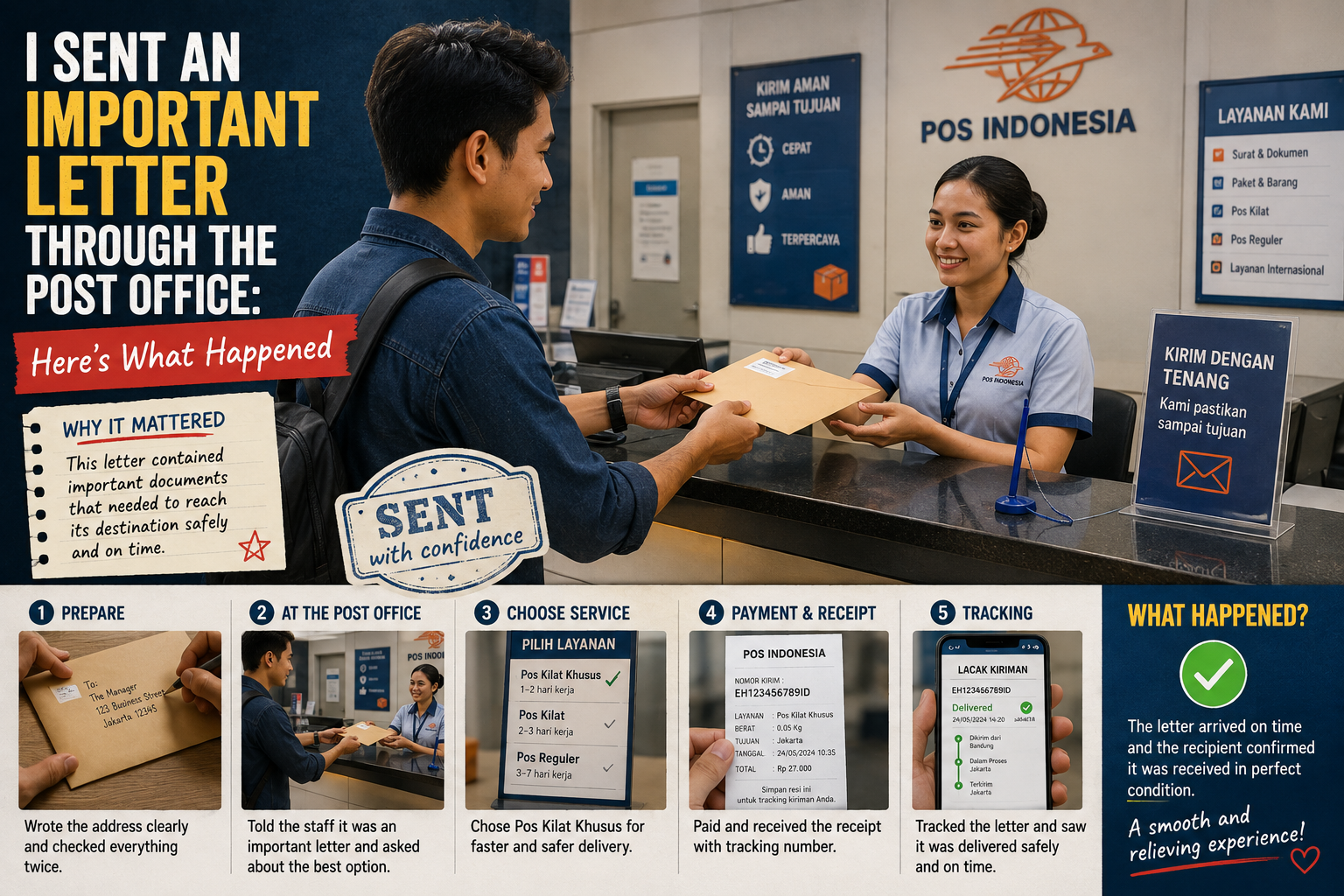
Once the letter was ready, I placed the documents inside an appropriate envelope.
The next step was writing the address.
I included the recipient’s name, complete address, city, and postal code. I also wrote my own information as the sender.
This was one of the most important parts of the preparation. An incomplete or incorrect address can potentially cause delays or make successful delivery more difficult.
I checked the postal code carefully because even a small numerical mistake could potentially send the letter toward the wrong destination.
After checking everything twice, I sealed the envelope.
My Visit to the Post Office
When I arrived at the post office, I was not completely sure which mailing service I should choose. Fortunately, the process was easier than I expected.
I approached the service counter and explained that I wanted to send an important letter to another city.
The staff asked a few questions about the destination and the type of delivery I wanted. They then explained the available options.
This was one of the first things I learned: you do not need to understand every postal service before visiting the post office. If you are unsure, simply explain your needs and ask for assistance.
Choosing a Delivery Option
There were different considerations when choosing the service. I wanted the letter to arrive safely, but I also wanted to keep the cost reasonable.
I asked whether tracking was available and how the different options compared in terms of delivery.
After listening to the explanation, I selected a service that seemed appropriate for the importance of the letter and the destination.
The decision felt much easier once I understood what each option offered.
Receiving the Receipt
After the letter was processed, I paid the required fee and received a receipt.
I immediately put the receipt somewhere safe.
It might seem like a small detail, but keeping the receipt is important when sending something that matters. Depending on the service selected, it may contain information that can be useful for tracking or confirming the transaction.
I was glad I had asked about this before leaving the counter.
The Waiting Period
The most interesting part came after I left the post office.
The letter was no longer in my hands. It had entered the postal system and was beginning its journey toward the recipient.
Unlike instant messaging, there was nothing I could do to make it arrive immediately.
I found myself thinking about how traditional mail works. The envelope would need to travel through different stages before eventually reaching its destination.
The waiting made me appreciate how different physical communication is from digital communication.
Checking the Delivery
Because I had chosen a service that provided shipment information, I was able to monitor the delivery progress.
Checking the status occasionally gave me reassurance that the letter was moving through the system.
I did not constantly check it, but seeing the progress was useful because the letter contained important information.
Eventually, I received confirmation that it had reached its destination.
That moment was surprisingly satisfying.
What I Learned
The experience taught me several simple but valuable lessons.
The first is to double-check the address. Names, street information, city details, and postal codes should be reviewed carefully.
The second is to choose the delivery service based on your actual needs. An important letter may benefit from a service with tracking or additional delivery features.
The third is to keep the receipt. It can serve as useful proof that the mailing transaction was completed and may contain important shipment information.
Finally, I learned that physical mail requires more patience than digital communication.
Why Traditional Mail Still Has Value
Technology has made communication faster than ever, but that does not mean physical letters have become meaningless.
A physical letter can feel more deliberate and personal. Someone has taken the time to prepare the document, place it inside an envelope, write an address, and arrange for its delivery.
For important documents and certain personal messages, that physical connection can still be valuable.
Final Thoughts
Sending an important letter through the post office turned out to be a simple but memorable experience. The process required careful preparation, accurate addressing, choosing an appropriate delivery service, and keeping the receipt.
The biggest lesson was that small details matter. A correct address, appropriate packaging, and suitable delivery option can make the mailing process much smoother.
While digital communication will remain the fastest way to exchange information, traditional mail still has its place. Sometimes, taking the slower route can make the act of communicating feel more intentional.
My letter eventually reached its destination, and the experience reminded me that even something as ordinary as an envelope can carry a surprising amount of meaning.